
Imágen de Yágul & Blossoming Organs - Eco-Feminism Art
In this essay, I will be exploring and comparing two works of art: Imágen de Yágul (1973) by Ana Mendieta and Blossoming Organs (2023) by Kei Imazu. These two works carry strong themes of women and rebirth told through the lens of nature and eco-feminist and environmental justice beliefs. Though ranging by 50 years in time of creation, both pieces call upon the same discussions and questions, standing true to their messages and perspectives.
The first piece of art I will discuss is Imágen de Yágul (1973) by Ana Mendieta. Ana Mendieta, born in 1948 in Havana, Cuba, is an interdisciplinary artist, best known for her earth and female body works. Her work has made lasting impressions, living in more than 120 public institutions and museums in the world. Throughout the 1970s and 80s, her work brought art critiques and appreciators to discuss and wonder on the feminist approaches of death and life told through the medium of the earth as the canvas of Mendieta’s choice.
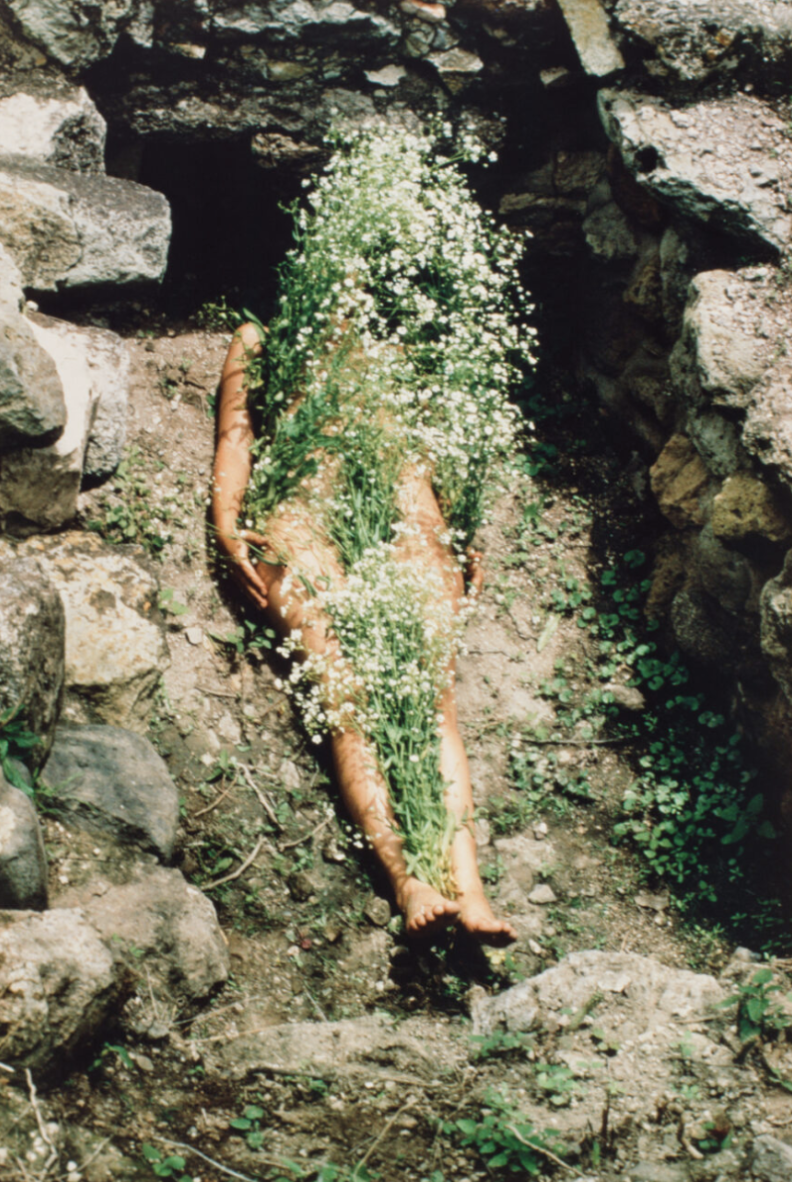
To dismantle the meanings of Imágen de Yágul, it’s important to translate the work’s title. Yagul is an archaeological site tied back to the Zapotec civilization within pre-Columbian Mesoamerica. So, the art translates to: Image of Yagul, Yagul being a place where colonization of people and land has taken place. The art depicts a woman (the woman seen is Mendieta) lying corpse-like in a rock built burial pit. White delicate flowers encompass the corpse’s outlines from the ground beneath her covering her face completely with only her fingertips, one arm, hips, parts of leg and feet seen by the viewer. The body is seemingly at peace in the tomb, fingertips brushing the hip and daylight illuminating parts of the body. The flowers, white and airy, could be Queen Anne’s Lace or Baby’s Breath, both intriguing flowers to use considering the art’s focus as being within the feminine and lifecycle.
The piece is inherently eco-feminist, exemplifying the female body as the vessel of life from the earth. From death to rebirth, Mendieta’s art claims earth as the true home and the female as the source of life. She spoke on this explaining that “My art is the way I reestablish the bonds that unite me to the Universe. It is a return to the maternal source.” (Ana Mendieta Artist). As a Cuban refugee coming to the U.S., Mendieta was exposed to colonialism and the destruction of post-war from a young age. Her works are said to “signify a return to a metaphorical womb and her native Cuban homeland as she molded a feminist subject and land art processes to explore the theme of exile." (American Art). This work, how it’s titled, and Mendieta’s identity, showcase how the implications of post-colonial patriarchal systems tend to forget (the forgetting being displayed through the work being underground and in burial), how women are the vessels of life, sustenance, yet at the cost of a woman’s life. Taken out of the narrative and most positions of power, women have long been assumed in history as just simplified life-giving sources. The female body in this image is seen as dead and decaying into the earth, acting as a fertilizer for new life to grow from the dirt where she lies. The degradation and destruction of the female body assumes that this resignation and surrendering or even abandonment of self will yield the possibility of new life to blossom. Through this piece, Mendieta ultimately raises environmental questions, awareness and discussion within eco-feminist concepts and lifecycles within women and nature.
The second piece of art I’ve chosen to consider is Blossoming Organs (2023) by Kei Imazu. This work of art, which spans over 11 feet wide and 6 feet tall, is the largest work in Imazu’s exhibition, “Sowed them to the Earth”, on display at Jessica Silverman. Kei Imazu, born in 1980 in Yamaguchi, Japan, now living in Bandung, creates art through mixed media, including 3D renderings of objects, digital collages, drawn sketches, and oil painting.
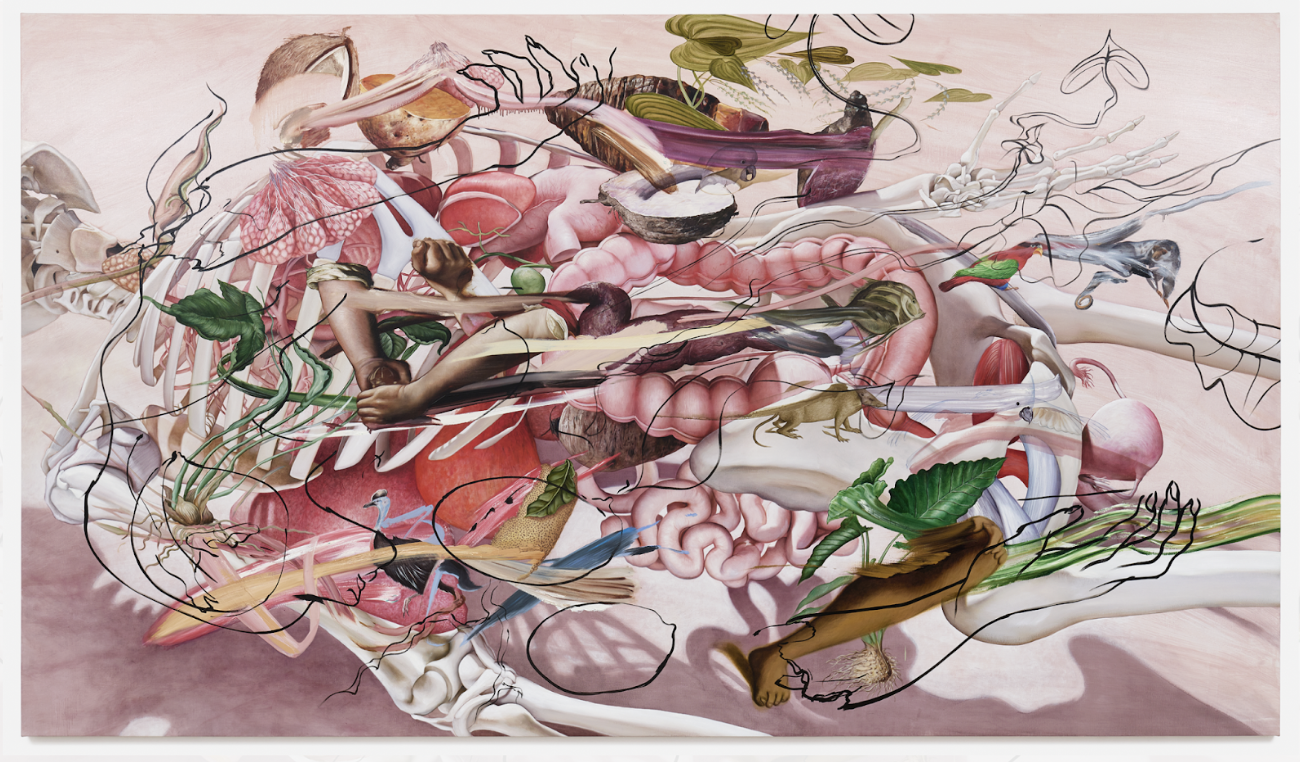
The piece is complicated to explain as there are many mediums and facets of the piece to break down. The main attribute is the first layer, which is a skeleton lying on a soft pink background. Within the skeleton, the second layer displays interwoven and seemingly random images of fruits, sproutlings, leaves, bulbs, birds, a monkey, a lizard, human limbs - arms, feet, intestines, organs, as well as coconuts and vegetables. The third layer is a black messy thick sketch of shapes, limbs, leaves and most clearly seen are two hands with long pointed fingertips.
In interview, Imazu mentions that this art drives inspiration from living in Bandung: “It’s a serene city, ensconced within mountains and replete with natural beauty. However, the nearby Citarum River is lamentably renowned as the most polluted river globally, primarily due to textile factories’ wastewater and widespread plastic litter.” She explains how resource driven acquisitions in WWII fed into capitalistic degradation of the land and that “In Indonesia, I palpably felt that the fecundity of both women and the land consistently remains a target in male-dominated structures.” Although Imazu’s home and how she sees capitalism, colonialism and patriarchy are important to understanding her views, it doesn’t really answer the mystery of what Blossoming Organs is getting at.
Rather, by looking at Indonesian and Javanese folklore and tradition, we can fully understand her art. In ancient Indonesian mythology, it is said that “root vegetables, bulbs, and other plants in the region resulted from the murder of the goddess Hainuwele. Her remains were buried in a pit, but parts of her body were later re-buried around various villages. From these sites sprung life-giving plants, including the Indonesian staple, tuber crops.” (Hyperallergic). The exhibition, including this piece, highlights how women and the Earth are used for regeneration, further addressing eco-feminism in a global landscape. The art is also derived from the Javanese tradition where the placenta is placed in a ceramic pot and buried after childbirth. Imazu explains in her own words how this tradition is recognizing the placenta as the spiritual twin, which was alongside nurtured in the mother’s womb. She explains how when she had her son and buried the placenta in the Indonesian soil afterwards, it was a very maternal experience and she felt connected to the experience as the burial symbolizes the emergence of the taro plant from the earth. Imazu reflected on the experience noting how “This very personal, maternal experience introduced me to the Hainuwele myth from Seram Island, which tells of the story of tuber plants sprouting from the body of a goddess upon her death, signifying the dawn of sustenance for humankind. This myth is at the heart of my exhibit.” It’s easy to see how her thoughtful explanation of the piece mimics female production of life and how through creating life, a woman also gives back to the earth and cultivates agricultural blossoming for her community. Although not explicitly mentioned, this comes at the cost of the woman’s body laying on the ground as a skeleton as we can clearly see in the piece.
In the first piece, Imágen de Yágul by Ana Mendieta, we see a female body laying in burial, flowers being grown where the body lies. In the second piece, Blossoming Organs by Kei Imazu, we see the female body as a skeleton being the vessel and creator of new life, animals, sproutlings, and environmental renewal. Both pieces are drawing from renewal of life and environmental growth built from taking from, destroying, or death of a woman. Both are showing signs of a life cycle from death to birth, signified through the coming home to earth.
These works of art unveil how life is born from the female body. From the cells that materialize and the embryo that forms, life in nature is sprung from the womb or egg of the woman. Nourishment in milk and warmth is of the woman’s home for a baby until it can become one’s own. Yet, we also see how in these pieces, gender and body create life and then get destroyed, capitalized and corrupted from a system built by the opposite gender. Destruction of the planet is facilitated and continued through a patriarchal system of capitalization and colonialism.
This idea is seen from the beginning of time to the present day with women taking from themselves (physically, mentally, financially, emotionally) to provide for their children and the next generation. The beautiful silver lining, as Mendieta hints at, is that the maternal source of nature and earth is inherently female. The concept of Mother Earth and the fact that women are at the forefront of championing sustainability advancement is an indicator of this. I would argue these works serve my beliefs that women inherently have a more profound, intimate, and symbiotic relationship with nature over men.
Where the pieces contrast each other is mainly through the mediums the messages are told. In Imágen de Yágul, Mendieta uses her own body and photography to capture the art through a comparatively simplistic image, whereas in Blossoming Organs, Imazu uses mixed media and digital art to superimpose the images upon each other. Beyond the mediums, the message is a little more easily understood through Mendieta’s piece whereas in Imazu’s piece, the message is more subtle as it can be difficult to fully understand the goal of the piece without her explanations and context. This being said, the environmental justice message comes across stronger in Blossoming Organs. She explains how historical colonization and river pollution have shaped her art, whereas Mendieta doesn’t offer as much context herself. Another important note is the age gap between the pieces. Imágen de Yágul was made in 1973 and Blossoming Organs was made 50 years later in 2023. Eco-feminism, a newer term and widely underutilized, is a concept Mendieta may have not even known about when she was crafting these works of art.
The two pieces deconstruct the environmental justice concepts of eco-feminism through exploring themes around land colonization and degradation as well as the utilization of the female body as a cause of growth and rebirth in nature. Though contrasting in composition and in range of timing, both pieces convey similar beliefs around lack of justice of the female body told through the mediums and stories of earth and nature.
